SpinningForth.com
Now spinning

Home
News snips
Now spinning
Articles
Products
Links


About me

contact Webmaster



Welcome to my workroom!
Let's see what's spinning today....


12 August 2008

It may look like an odd colour wheel soaking in a sink (left), but it's really a rescue mission.

Our household project of Packing Things Up continues, and the most amazing half-forgotten things come to light in the process. Today's discovery: in a big box, surrounded by golden silks, rich blue wools and luxurious green blends (natural dye projects, all), I found the other, shabbier results of Dyepots Past. Bundles and bags of experiments that didn't work. Colours that aren't really colours cowering miserably in unlabeled disgrace.

My, my, my, my, my.

Not every promising plant lives up to its dye potential, alas. Every natural dyer who's experimented with local materials knows this colour (right) very well. Anne Bliss, in her excellent hand-sized book North American Dye Plants, described it in clear, unflinching terms: "blah beige".

The fibre itself is beautiful: a fine merino-cross wool from the Falkland Islands, perfect for using as-is, or for blending deliciously with silk. It was great to find it again -- except for the colour. ...And there was a lot of the stuff, varying only in degrees of blahness or beigeness!

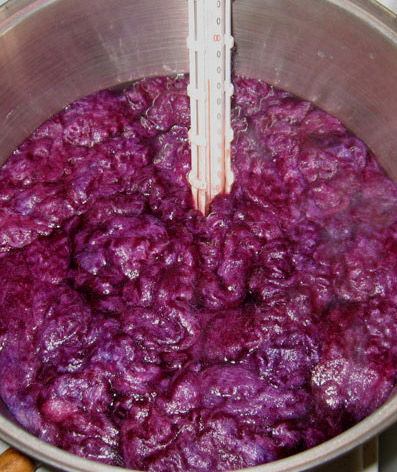
Enter the stainless-steel dyepot and some acid dye stock solutions that I needed to use up anyway. With firm resolve, I coiled the wool in the bottom of the dyepot and added just enough water (mixed with 100 ml of vinegar) to thoroughly wet the wool, but not enough to slosh around. When the wool was completely wet, I smooshed out the remaining air bubbles and applied some diluted (0.25%) dye solution (left).

I lit the stove, placed a heat diffuser over the flame, put the pot on the diffuser, and waited. When the liquid was hot enough to steam, I turned the flame down to Low and set the timer for half an hour. As the time passed, the colours blended and feathered beautifully (right).

The biggest concern with doing a dye project this way is the very real risk of scorching the fibre. The dyepot contained a total of less than 2 liters of liquid, which meant the wool was actually in contact with the bottom of the pot -- not my usual method of doing things! ...The diffuser helped. The lower heat helped, too. I figured this approach would probably work just fine -- and if it didn't, the dyebath wouldn't exhaust, or the fibre wouldn't rinse clear, or there would be obvious felting and matting, and the problem would show itself right away.

Guess what???
The dyebath exhausted.
The fibre rinsed clear.
There's neither felting nor matting.

And it's wonderful (left)!

There's still more rescue-dyeing to come in days ahead (I found many, many bags of beige wool!), which means there will eventually be a generous supply of rainbow-dyed roving begging for a project.

That this wool will become yarn is certain, and it's also clear that I'll keep the colour movements intact (mostly) in the spinning. But the destiny of this colourful woollen yarn.... Is this the opportunity for me to weave overshot with refreshing, modern colours in the pattern weft???

I think it might be. Stay tuned.


06 August 2008

Yesterday began with one of those mornings.

Our apartment is due for some major Work. There's a seriously leaky roof (and falling plaster), and the wiring is about 50 years out of date. We're going to have some people come in to prepare bids, but before that can happen the apartment needs to have all its flaws visible; and what that means, in terms of daily life, is that everything (everything!) needs to be packed away into boxes so the walls, the baseboards, and the problems are out in plain view.

Putting things away is not my strong point, and packing everything into boxes where it will stay for several months makes me feel... like a cat in a garbage bag.

Luckily, there's a sure-fire remedy for a morning that has turned rough: bright fibre, a spinning wheel, and a big cup of coffee!

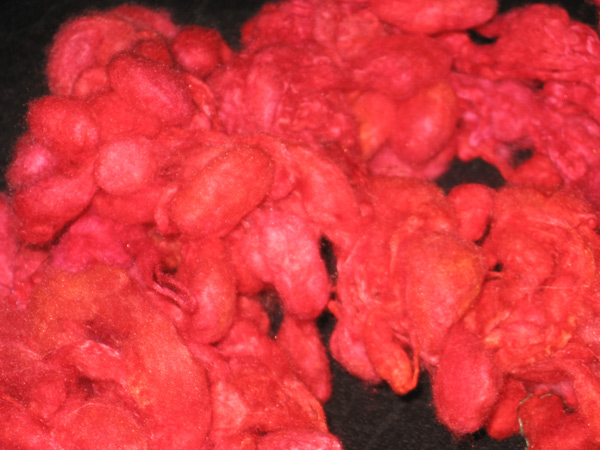
This (right) is one of the prizes for sorting and packing: near the stash basket, I rediscovered this red wool in a stack of baggies. It had originally been the byproduct of an adventure with a "free" fleece (you can read about the fleece here).

The baggie contained just enough wool for a nice skein, and its locks were fairly intact; so I decided to comb it. A pleasant hour spent with a pair of Louet mini-combs resulted in a tempting, cheering stack of bright red sliver. The coffee was hot. The day was already looking better.

This wasn't my first time spinning this particular wool. Earlier this year it got spun into a comfortably cushiony woollen yarn (you can see a close-up of that first yarn here). The colour is rich and vibrant in that original woollen -- but I decided to spin this batch worsted, just to see what difference it would make. (Besides, I'd already combed all the wool, so why not??)

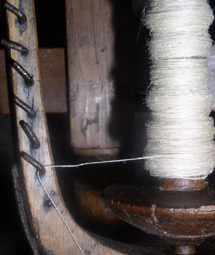
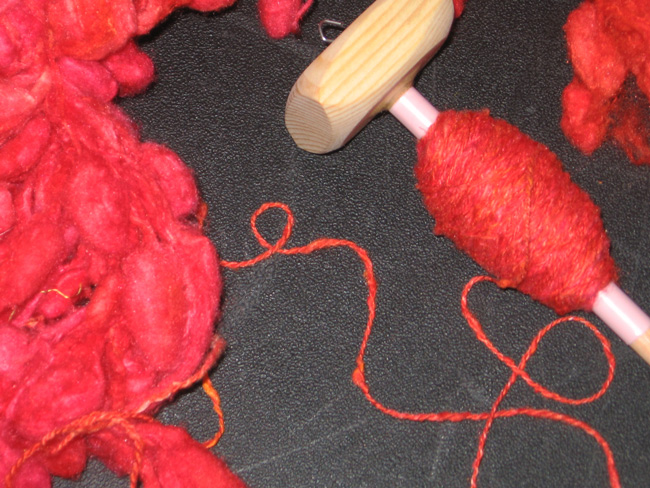
I oiled the wheel, grabbed a comfortable chair, and... it's a very nice spin (left). Certainly, I'd been a little distracted while combing, so a few tiny neps got left in each strip of sliver -- and now and then a tiny crumb of debris tumbles out as I draft; but this wool responds to the "short-draw" technique of drafting as though the sheep had had that in mind as it grew the wool. The photo shows the yarn-in-progress, between two drafting movements.

Having been around this particular block before, I know better than to expect my pretty red worsted yarn to stay smooth and dense -- it is, after all, spun from a fuzzy, springy, crimpy wool! It will undoubtedly puff up when I wash it. That's the nature of a downy breed.

That's all right with me, though. I enjoyed being immersed in such an intense colour for those few hours. Also: it's nice to keep the different techniques in shape (we don't want them to get rusty!), and I hadn't spun worsted for a while. This was a lovely, finite treat.

And even though I didn't spin it all in one sitting, it saved the day. ;-)


28 July 2008

Big bamboo.

Beautiful, sleek, shiny, supple, dense, cool, elegant, well-behaved bamboo. In heartstopping green, with just a breath of other tints shimmering here and there.

This is the bundle of fibre that came home with me from Convergence, and I've fallen head-over-heels in love. I've spun bamboo fibre before (in fact, there's still a generous baggie of the uncombed variety somewhere around here), but the other bamboo fibres I've met were never this nice.

In spinning, this stuff is very much like silk -- except that it has no tendency toward static electricity, and it doesn't stick to your fingers in hot weather. The yarn it makes reminds me of Tencel -- except that this sheen is softer and less synthetic-looking, and this yarn's density doesn't also make it feel heavy.

The density is addictive --it will make a fabric that drapes sensually (that's sensually, with a capital Mmmmm!). The sheen is addictive. The colour is addictive. The drafting is delightfully addictive. ...I'm hooked! :-)

A question nags at me, though: what is this bamboo fibre, really??

It looks and feels similar to many "regenerated" fibres -- the ones that have natural, plant-based origins, but whose fibre structures are created by an entirely industrial process. In fact, I'd assumed that's what we were talking about here (having extensively examined the several kinds bamboo plants in this area and finding nothing spinnable in their makeup) -- but a couple of documents have crossed my desk that suggest otherwise.

The question demands more research, and I'll do that; but for the moment I'm happy to float on this lovely green cloud.

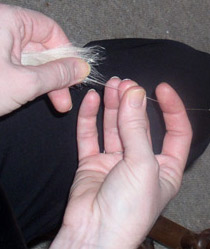
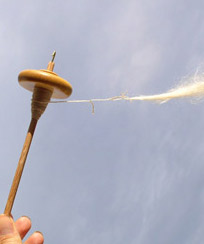
These bamboo fibres are smooth, shiny, slick, and about 4 inches long (left). Compared to silk, they remind me of A1 cultivated bombyx -- they're much smoother and slipperier than tussah silk tops. In spinning, too, they're reminscent of the smoothest silks, but they're more... more everything.

They are, in fact, so slippery that they require a small, well-controlled drafting zone to keep the yarn consistent, and to keep the fibres from simply sliding past each other as though they had minds of their own. Considering that the fibres are not short, that was a bit surprising. (It's worth it, though. I'll give these fibres whatever they want!)

In addition to a small, tightly-monitored drafting zone, this bamboo takes a lot of twist. ...Let me rephrase that: this bamboo takes a lot of twist! Without adequate twist, the yarn drifts apart with startling alacrity.

The other side of the situation is interesting, too: the yarn absorbs the twist and claims it for its own without snarls, rough spots, or snags. A highly-twisted singles of this bamboo feels like a lightly-twisted singles of, say, Tencel -- or a moderately-twisted singles of silk. In fact, to force this bamboo yarn to the point of true "overtwist", you need to apply yourself! The stuff is just... nice.

It holds still obediently for plying -- no snarls, no cursing. The plied yarn loses nothing of the beauty of the singles, either; instead, it amplifies it.

This new bamboo makes an exceptionally well-behaved yarn, stunningly suited for any situation that requires high twist or durability. ...That such a yarn can also have an endearing sheen and a lovely hand is just too wonderful for words.

I'm in love.

Again.


End notes, for inquiring minds

♦  The beautiful hand-painted bamboo fibre came from the dye studio of The Fiber Lady, whose business blossoms in Lewisville, Texas. The fibre is lovely (in case I forgot to mention that), and her other colourways are equally gorgeous. Click here to visit her website.

♦  The spindle shown here is one that I made -- and they are available for purchase, if you were wondering! Click here for more information.


21 July 2008

Convergence 2008.
Tampa, Florida.

I was there.

To take this to a deeper and more personal level: I was also at the Complex Weavers Seminar in St. Petersburg, Florida, which spanned three thrilling, fulfilling days in the wake of Convergence.

One of the great things about the Internet is that you can be in touch with so many people in so many different places; but there's really nothing to match the experience of talking with people in person, face to face. ...It was lovely to meet so many of you during Convergence. Our world of handspinners and weavers really is a nice one. :-)

During Convergence itself, I was part of the extensive booth put together by Berlin Braids (also known as my dear friends Shirley and Peter Berlin). I was the one working in the middle, between (on one end) the Berlins and their beautiful marudais and braiding kits, and (on the other end) Ziggy Rytka, with his lightning-speed, elegant lucets.

Over the past few years I've discovered that I really love teaching, to the point where I'm totally hooked on the look of beaming pleasure that lights the face of someone spinning silk for the first time. I don't know how many people I taught to spin at our booth during Convergence -- but I can assure you that I enjoyed every minute of it!

Being a vendor means you don't get to shop as much as you might otherwise do -- but by applying my significant experience and fast-draw wallet techniques, I was able to work around that. ;-) I came home with the new "Best of Weaver's" book on overshot, a brand-new book on fingerweaving techniques, two large cones of UKI mercerized cotton, and a satisfyingly dense baggie full of richly dyed bamboo top in a heartstopping green (the leaves in Florida's sub-tropical flowerbeds are but pale echoes of this gorgeous stuff!).

Too reasonable, you say?? Okay -- then I'll confess that I also bought a couple of beautiful handblown glass beads (perfect pendants to hang on a braid -- you'll be seeing them in that guise soon), a lovely pair of dichroic glass earrings, and two gorgeous skeins of hand-painted Tencel yarn in the rich hues of a deep tropical pond.

The biggest prize, though, came in the form of new friendships -- especially the ones that unfolded during the Complex Weavers Seminars. New friends and old, I'm smiling as I type this, thinking of you (plural) and our conversations.

It was a good time.


Are you looking for something that used to be on this page?
Take a stroll through the Archives!


Return to top of page